Shed Doors, Cold Tea and Stubborn Beans: An Allotment Portrait Morning
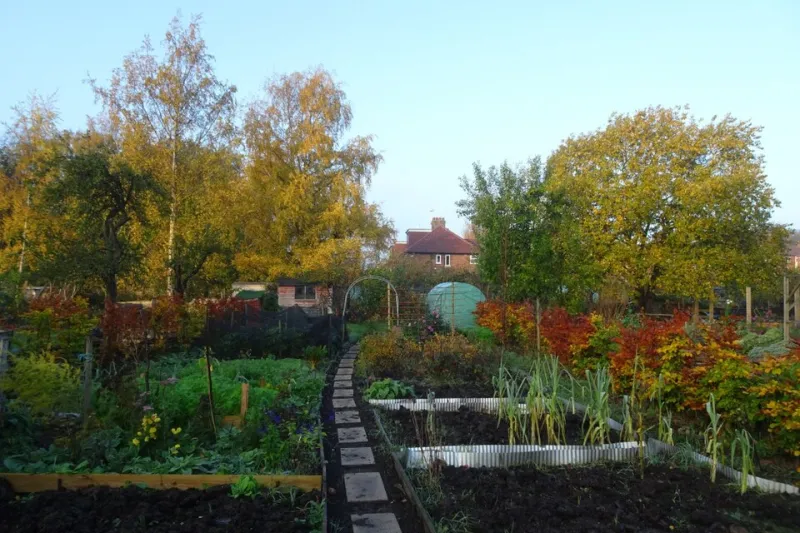
Photo: DS Pugh , CC BY-SA 2.0, via Wikimedia Commons
November on a UK allotment site does not announce itself with a fanfare. It arrives as a gate that sticks, a path of compacted leaves, and a row of sheds that look like they have been holding their breath since October. By mid-November, most plots are caught between harvest and hibernation. There are still things growing — leeks, kale, the last stubborn runner beans — but the main crop is atmosphere. For a photographer, that is the point.
Arriving Before the Light Does
Get there early, but not so early that you are photographing in blue-black murk. In November, useful light may not arrive until well after eight, and it will be gone by half three. Use the first hour for reconnaissance. Walk the main path, note which plots have people working, and resist the urge to start shooting through fences. Allotments are private spaces even when they look public. A quick hello and an explanation of what you are doing will get you further than any long lens.
The arrival is also a useful photographic moment. Plot holders come in with flasks, carrier bags, secateurs and a look of mild determination. Frost sits on the grass edges. A kettle clicks on in a shed. These are the frames that set the scene before you ask anyone to stand still.
Flat Light Is Not Bad Light
November light is soft, low and often grey. Beginners call it dull. Portrait photographers should call it forgiving. There are no hard shadows under noses, no squinting into a sun that has forgotten its angle. The trade-off is that everything is darker than it looks. Raise your ISO earlier than you think, keep the aperture around f/2.8 to f/4 if you want the shed and the person both readable, and watch your shutter speed when the wind picks up.
Do not meter for the sky. Meter for faces and hands. If the frame includes a bright white sky above a dark hedge, expose for the person and let the sky go pale. In November, a blown sky often looks better than a muddy face. If you are shooting on a phone, tap on the face and drag the exposure down slightly — flat light can trick phones into over-brightening skin.
The Shed Door Portrait
Every allotment site has a row of sheds that are doing more work than they realise. Peeling paint, galvanised hinges, a hook where a coat used to hang. A shed door makes a natural backdrop because it belongs to the person standing in front of it. It is not a seamless studio wall; it is a surface with history.
Position your subject just outside the doorway, not inside it. The doorframe gives you a frame within a frame, and the open shed behind them gives depth without becoming a black hole. If the shed is dark inside, tilt the door so it catches what little light there is. Ask them to keep doing what they were doing — sorting seeds, wiping a tool, holding a mug — rather than facing you square on. The best shed portraits look like interruptions, not appointments.
Hands, Tools and the Truth
Allotment growers have photographable hands. Not because they are gnarled in some romantic way, but because they are busy. Mud under the nails, a wedding ring, a plaster, the pale line where a glove has been. Photograph them. A portrait that includes hands holding a trowel or a handful of beans says more than a head-and-shoulders shot ever will.
Give people something to do. Ask them to show you the last of the crop, to point out the shed repair they are proud of, to pour tea from the flask. The moment they stop performing for the camera is usually the moment the picture starts. Keep talking, keep the camera up, and shoot through the small movements. The frame after the smile is often better than the smile itself.
Clutter Is the Story — Until It Isn't
Allotment plots are visually noisy. Cane wigwams, plastic pots, netting, a wheelbarrow with a flat tyre, a stack of wood that is definitely going to be useful one day. That clutter is part of the story. Do not clear it all away and make the plot look like a garden centre display. But do edit one thing. Move a bright orange bucket out of the corner. Step half a metre to the left so a stray fork is not growing out of your subject's ear. Small adjustments preserve the truth and tidy the frame.
Look for texture: frost on a water butt, moss on a paving slab, rust on a hinge, the ribbed plastic of a compost sack. These details work as breathing space between portraits. They also give you something to photograph when the grower needs a break from being looked at.
Stubborn Beans and Small Harvests
By November, the runner beans are usually hanging on out of sheer stubbornness. They may be tough, stringy and slightly frost-bitten, but they are photographically perfect. Get low. Put the beans in the foreground and the grower behind them, slightly out of focus. Use a shallow depth of field to turn the plot into a wash of muted green and brown. Do not over-saturate the colours in editing. November is rust, sage, damp wood and cold skin. Let it look like that.
The same goes for the small harvest: a handful of kale, three leeks, a single late courgette. Photograph the harvest in the hand, not on a chopping board. The story is in the walk back from the plot, not the styled recipe shot.
The Brew Break Is the Best Bit
If you are invited into a shed for tea, say yes. The flask is a prop, a conversation starter and a way to slow the morning down. Steam in cold air is one of the great November photographic gifts. Backlight it if you can, or place the mug against a dark shed wall so the steam reads. Photograph the mugs on the bench, the biscuit tin, the gloves taken off and left in a heap.
This is also when people tell you the real stories — the neighbour who gave them the bean seed, the year the shed flooded, the fox that keeps digging up the onions. You do not need to photograph all of it. You just need to let it inform the frames you make afterwards.
Leaving With Mud on Your Knees
Before you go, thank the people who let you in. Close the gate. Do not walk across beds to get a better angle. If children are on the plot, ask a parent before photographing them, and accept a no without negotiation. Allotment sites are communities before they are locations.
On the walk back, look at what you are leaving behind: the shed doors, the frost melting on the paths, the last runner beans still hanging on. November does not give you much light, but it gives you something better for portraits — people who are busy, unposed and entirely themselves. That is worth a cold morning and a flask of your own.