Stacked Chairs, Strip Lights and the Truth: Portrait Lessons from a Village Hall
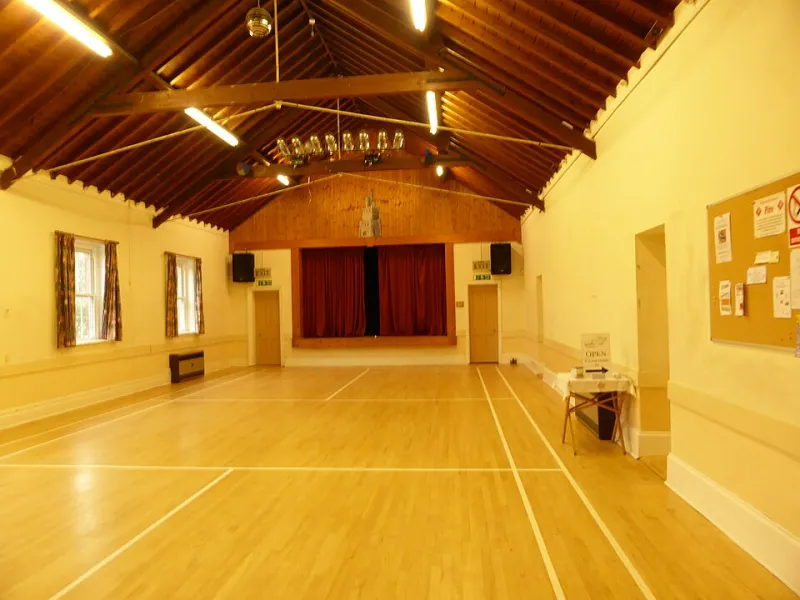
Photo: Bob Harvey , CC BY-SA 2.0, via Wikimedia Commons
The booking secretary hands me a key on a wooden fob the size of a biscuit. The room smells of floor polish, old tea and the faintly electrical hum of a strip light that has been waiting all day. There is a stack of chairs against one wall, a stage curtain the colour of a bruised plum, and a noticeboard advertising a pilates class and a quiz night. It is not a studio. It is better than a studio.
The Room Does Not Need to Be Beautiful
A white cyclorama tells a subject to perform. A village hall tells them to relax. The parquet is scuffed, the kitchen hatch is propped open, and somebody has left a laminated fire notice slightly crooked. None of that is a problem. In fact, it is the reason the pictures work.
Ordinary British rooms carry recognition. People know the smell of a church room, the squeak of a community centre chair, the particular light of a hall that has hosted jumble sales, birthday parties and parish council meetings. When someone sits down in that environment, they do not turn into a model. They turn into themselves, only slightly more aware of it.
My approach is simple: do not try to make the hall look like a studio. Use what is there. The stacked chairs become a frame. The stage curtain becomes a backdrop. The noticeboard becomes a bit of social context. You are not removing the room. You are letting it speak quietly behind the person.
Asking Properly: Permission, Parish Councils and the Tea Urn
None of this works if you treat the hall like a free location. Village halls and church rooms are community infrastructure, usually run by volunteers or a small committee. Email the booking secretary, explain what you want to do, and ask about the hourly rate. In many parts of the UK it is modest — sometimes the price of a couple of pints — but pay it. Offer to send a few images afterwards. Turn up when you say you will.
Ask practical questions in advance. Is the heating on? Are there tables out? Can the stage curtains be closed? Is there a regular toddler group or yoga class before you? Is there parking, and is the kitchen available for changing? Do not assume you can move the piano. Do not unplug the fridge. Do not leave gaffer tape on the parquet.
It also helps to mention that you are a photographer working on portraits, not a film crew. A small kit and a clear plan reassure people. If the hall has a committee, a brief, friendly email is your friend. The tea urn is not a prop. It is a test of whether you are the sort of person they want back.
Working With Fluorescent Strip Lights
Those long tubes are not flattering, but they are honest. They also flicker, cast a greenish colour and make everyone look slightly like they are in a 1980s staff canteen. You can fight them or you can work with them.
If the hall has windows, use them. Turn the strip lights off if you are allowed, and let daylight do the work. If you cannot turn them off, bring a small LED panel or a speedlight with a white umbrella to lift the face and give yourself something to balance against. A white balance card is worth the pocket space. In the UK, older fluorescent fittings can cause banding, so keep an eye on your shutter speed and test a few frames before you commit.
Sometimes the flat overhead light is the point. A deadpan portrait under a strip light, with the hall stretching out behind the subject, can feel more truthful than a beautifully lit headshot. The trick is to expose for the face and let the room fall where it falls. You are not selling a fantasy. You are making a record of a person in a place.
Stage Curtains, Stacked Chairs and Other Found Backdrops
The stage is the obvious gift. Close the curtains and you have a deep, textured backdrop that flatters almost anyone. Ask your subject to stand where they would stand in a Christmas panto, or where they stood at school assembly. The memory does something to the shoulders.
Stacked chairs are not just clutter. They give you height, repetition and a bit of British civic texture. Use them as a frame at the edge of the shot, or sit your subject on a single chair pulled slightly away from the stack. The kitchen hatch is another useful frame: shoot through it, or use it as a bright rectangle behind a darker portrait. The noticeboard, the clock, the fire exit sign — leave some of them in. They tell you where you are.
Do not over-clean the frame. A portrait in a village hall should still look like a portrait in a village hall. If you clone out every scuff and notice, you remove the story.
The Awkward Bits Are the Point
A hall shoot will always have awkward bits: the mop bucket, the stack of folding tables, the fluorescent buzz, the slightly too-warm kitchen. Lean into them. Ask your subject to lean against the stage, sit on the edge of the platform, or stand by the noticeboard. Give them something to do with their hands. The room is full of prompts.
I like to shoot a wide frame first, showing the person in the space, then move in for a closer portrait. That pairing gives you context and connection. It also gives the subject time to settle. By the time you are close, they have stopped noticing the strip lights.
A Short Kit List for a Hall Shoot
Keep it light: one camera, a 35mm or 50mm lens, a small speedlight and umbrella, a compact LED panel, a white balance card, gaffer tape, an extension lead and a step stool. A cloth for wiping marks off the floor is not a bad idea either. You do not need a full studio. You need to be mobile, quiet and polite.
Leave It Better Than You Found It
Stack the chairs. Wipe the marks. Pay promptly. Send the images you promised. Village halls are not glamorous, and that is precisely why they are worth protecting. They give photographers something rare: a room that does not try too hard. The best studio in Britain might have a tea urn, a laminated fire notice and a key on a wooden fob. It will not look like a studio. That is the point.