The Quietest Shutter: Shooting Remembrance Sunday Without Making a Spectacle
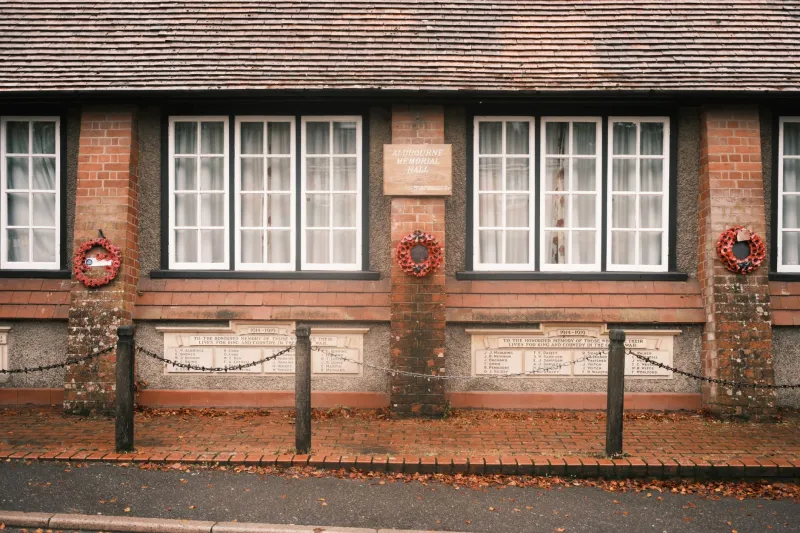
On Remembrance Sunday 2026, the temptation is to arrive early, find the best angle and come away with a full card. But a local act of remembrance is not a spectacle, and it is not content. It is a gathering of people who have chosen to stop, remember and stand together. The camera has a place there — just not the loudest one.
I have photographed enough village services and town memorials to know that the strongest frames rarely come from the front row. They come from the edges: a hand steadying a wreath, a poppy pinned to a wool coat, a bugler's fingers before the Last Post. This is a guide to shooting Remembrance Sunday with restraint, written for the photographer who wants to witness rather than intrude.
The Camera Is a Guest
Before you photograph anything, speak to the organiser. That might be the local Royal British Legion branch, the parish clerk, the vicar or whoever is marshalling the parade. Ask where you can stand, whether photography is welcome and what should be avoided. Some services have clear boundaries around the memorial; others are more relaxed. Either way, asking first changes the tone of the whole morning.
Turn off the shutter sound if you can. Mirrorless cameras and quiet modes are a gift here. No flash, no burst shooting, no crouching in the aisle during the two-minute silence. Dress like a person attending the service, not a photographer on a shoot. A bright camera bag and a monopod clattering on wet paving stones will make you the story, and that is the opposite of what you want.
Where to Stand, and Where Not To
Stand off-axis. Find a position to the side or slightly behind the main gathering, where you can see faces without blocking anyone's view. A 70–200mm lens is ideal; it lets you work from a respectful distance. An 85mm is lovely for details. A wide lens is useful for context, but resist the urge to make the parade look like a film still.
Do not stand between the congregation and the memorial. Do not plant yourself behind the officiant. Do not lean over children or step into the space where families are laying wreaths. If someone asks you to move, move without debate. The service does not owe you a photograph.
The Small Frames That Carry the Day
Wide parade shots have their place, but they often flatten the day into a procession. The smaller frames carry more weight. Look for the poppy pinned slightly askew on a coat. The medals catching a weak November sun. A wreath ribbon lifting in the wind. A handwritten card tucked into greenery. The bugler's hands. A folded order of service in a gloved hand. Wet tarmac reflecting the memorial's lettering.
These images are respectful because they do not turn grief into a close-up. They let people keep their privacy while still telling the story of the morning. When it comes to uniforms, avoid reducing them to costume. Photograph the cap badge, the salute, the polish on a shoe, the way a veteran's hand rests on a lapel. A full-face frame during an emotional moment is rarely the one you need.
Wreaths, Poppies and the Problem of Cliché
The poppy is a powerful symbol, and that makes it easy to overdo. Avoid the staged poppy-on-the-lens shot. Skip the heavy filters and the dramatic black-and-white conversion that turns a quiet morning into a poster. Look for real poppies in real contexts: ceramic poppies on a memorial, a paper poppy on a coat, petals scattered on paving. If you photograph a wreath-laying, shoot from the side and wait for the hands leaving the ribbon. The moment after the pose is often the truest.
Colour can be gentle here. November light is already soft and grey; you do not need to crush the shadows to make it feel serious. A restrained edit will age better than a heavy one.
When Not to Raise the Camera
During the two-minute silence, lower the camera. During prayers, the Last Post and the laying of wreaths by families, think carefully before you lift it. If someone is crying, do not photograph them. If a child is standing with a parent, do not zoom in for a close-up. If you are the only person moving, you are probably in the wrong place.
This is not about missing the moment. It is about understanding that some moments are not yours to take. The most respectful image is sometimes the one you choose not to make.
Editing With Restraint
Cull hard. A dozen good frames will tell the story better than two hundred. Sequence them simply: arrival, gathering, silence, wreaths, departure. Do not over-crop faces. Do not add grain for atmosphere. Caption names only with permission. If you are working for the branch or the parish, offer the images to them first. Ask before posting close-ups on social media, especially of children and grieving families.
Remembrance Sunday is not a wedding. There is no couple waiting for the album. There is a community, a memorial and a shared pause. Photograph it as if you were trusted with something quiet. Because you are.
The best frame from the morning might be a small one: a poppy, a hand, a ribbon, a reflection. It will not shout. It will simply remember.