Steam, Slush and String Lights: Turning a Christmas Market into a Photo Story
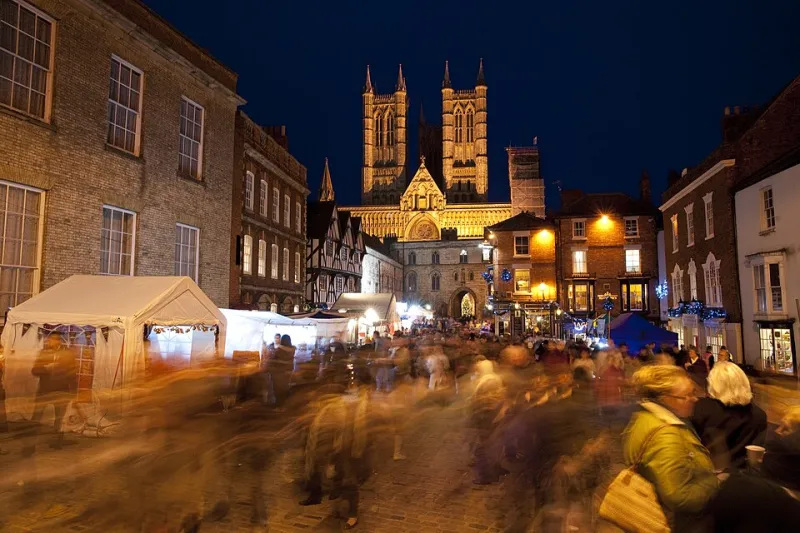
Photo: Virgin Trains East Coast, CC BY 3.0, via Wikimedia Commons
Christmas markets in the UK are not really alpine postcards. They are wet tarmac, a brass band doing its best, wooden chalets that smell of frying onions, and someone in a thin Santa hat pretending they are not freezing. That is the story worth photographing. If you turn up and fire off a dozen shots of pretty stalls, you will come home with decoration. If you arrive with a beginning, middle and end in mind, the market’s chaos does the rest.
Start Before the Lights Win
Get there in the last half-hour of daylight. That is when the market is still a place rather than a set. The bulbs are on, but the sky still has some blue in it, and the wet pavements are doing the reflective work for you. Find a wide frame that says where you are without relying on a banner: the edge of the square, the row of chalets, the first queue forming at the mulled wine stand. Expose for the lights and let the sky go a little deep. Keep your ISO high enough to hold the scene steady. This is not the moment for clean, bright postcard brightness; it is the establishing shot.
The Opening Frame Is Usually a Detail
A market story does not begin with a sign. It begins with steam curling off a paper cup, a stallholder lighting a burner, a child’s hand wrapped around a hot chocolate, or the first mince pie being slid across a counter. Look for a frame that gives the viewer a temperature. Cold hands, warm cups, breath in the air, mud on boots. Those details tell the reader what the night feels like before you show them the full crowd.
In the Middle, the Crowd Is the Story
It is tempting to treat people as obstacles between you and the stalls. Do the opposite. Work the edges of the crowd and let the crowd layer itself: a shoulder in the foreground, a tray of mulled wine in the middle, string lights and fake snow in the background. Wait for gaps rather than pushing through. A 35mm or 50mm lens is enough; you do not need to stand across the square with a long lens and turn the event into surveillance.
The cramped wooden chalets are where the market feels most British: elbow room is minimal, the card machine is held together with hope, and the person serving you is wearing three layers and a paper hat. Buy something, ask with your eyes before lifting the camera, and photograph the transaction rather than the display. Hands passing change, a ladle hitting the pan, tongs lifting something hot out of oil. Those frames have more life than any tidy row of baubles.
Low Light Without the Flash Gun
Mixed lighting is the reality here. Tungsten bulbs, LED strips, a blue police light, the orange glow of a burger van, phone torches and fairy lights that are more decorative than useful. Do not try to white-balance the magic out of it. Keep the warmth. Shoot raw, expose for faces where you can, and accept that some highlights will blow. A little clipping in a fairy light is not a failure; a dead, flash-lit face in the middle of a Christmas market is.
Use the reflections. Wet paving doubles the lights, shop windows add depth, and puddles turn a messy street into a second frame. Get low for a reflection, but keep the mud and the slush in shot. The grit is what makes the picture feel like a real December night rather than a stock image. If someone is shivering, let them shiver. If the fake snow is getting soggy underfoot, include it. The market is not tidy, and your story should not pretend otherwise.
Find the Ending After the Last Cup
The end of a Christmas market is not the pretty exit shot. It is the pack-down. Stacked cups, a brush moving slush across the cobbles, stallholders counting change under a single bulb, the lights going off row by row. Give yourself ten minutes after the crowd thins. That is where the sequence closes. A final wide frame of the square looking emptier than it did at the start will do more than another photograph of a wooden reindeer.
Edit for Change, Not Quantity
When you get home, build the story in order. Establish the place, move into details, show people interacting, then end on the aftermath. Twelve to twenty frames is plenty. If you have thirty pictures of stalls that all say the same thing, cut them. Choose frames where something changes: a cup is filled, a hand reaches out, a face reacts, a light goes off. The market gives you chaos; your edit gives it a shape.