Tombola, Tug-of-War and the Empty Field: Shooting a Village Fête as One Story
There's a moment, about twenty minutes before a village fête officially opens, when the field is full of people doing nothing photogenic at all. Someone is wrestling a trestle table into position. A child is being told, firmly, not to touch the cake stall. The tea urn is making that noise tea urns make. Most photographers wait for the ribbon to be cut. That's the mistake.
The fête is one of the great underrated subjects in British photography, precisely because nobody treats it as a subject. It's small, it's local, it's over by four o'clock, and it happens on a patch of grass you could probably walk across in ninety seconds. Which is exactly why it works. One field, one afternoon, one story — you just have to decide what the story is before you start pressing the button.
The frames nobody shoots first
Begin before the crowds. Details establish place faster than any wide shot, and they cost you nothing but a bit of kneeling in damp grass.
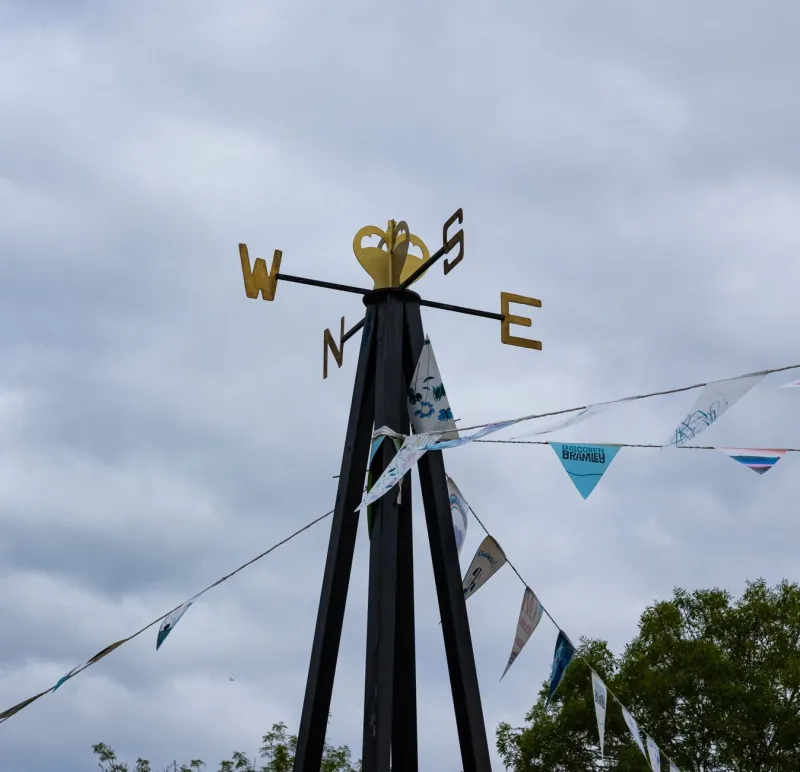
Look for the tea urn and its queue of mismatched mugs. The tombola table with its rows of tins, each one labelled in biro. The hand-painted sign that says something like 'PLANTS — 50p EACH — PLEASE HONEST' with a biscuit tin for the money. A bunting line against a grey sky. The raffle tickets fanned out like a hand of cards.
These are your establishing shots, and they do a job a wide landscape can't: they tell the viewer what kind of day this is. A wide shot of a field says 'field'. A close-up of a homemade jam label says 'this village, this Saturday, these people'.
My rule of thumb is to spend the first half hour almost entirely on details. You'll feel like you're missing the action. You aren't — the action for the next four hours is largely people standing near a stall.
Choose one thread and follow it
Forty frames is a rough, honest number. It's about what a fête will genuinely give you if you shoot with intent instead of spraying. But forty frames only become a story if they share something.
Pick a thread. It can be visual or thematic, and it should be boringly simple:
- Hands. Every frame that includes hands — counting change, holding a Pimm's, gripping a tug-of-war rope, pinning a rosette.
- The colour red. Bunting, a child's anorak, the tombola drum, a first-prize ribbon. Suddenly your edit has a rhythm to it.
- One family. Follow the same group across the afternoon and you get a mini-essay inside the wider story.
- The tea urn as a clock. Every time you pass it, shoot it. By the end you have a timeline disguised as repetition.
I like the hands thread best. It's unobtrusive, it works in flat light, and it captures the actual labour of a fête — which is nearly all labour, when you look closely.
Portraits without the parade
A fête is a gift for portraits because everyone is already slightly self-conscious, which is somehow better than being relaxed. People dressed for a occasion they don't quite have a dress code for.
Ask permission, keep it short, and don't move anyone anywhere. The best fête portraits happen where the person already is: the stallholder behind her cakes, the vicar mid-sausage, the kid with a face-painted tiger who has entirely forgotten he's wearing it. Frame tight, wait for the second expression — the one after the posed smile collapses — and shoot that.
If someone's holding a prize, a plant or a plate of chips, let them hold it. Objects give hands something to do and give the viewer something to read.
Action, and the art of standing in the right place
The set-piece events are where most cameras come out, and they're also where most photos look the same. Tug-of-war especially: everyone shoots it side-on from the middle, and everyone gets the same picture of a rope and some straining faces.
Try the ends of the rope instead. Try behind the anchor person, looking down the line. Try the spectators — the small kids copying the pose, the dog barking at nothing in particular. Try shooting low so the rope cuts across the frame. The action is the excuse; the reactions are the story.
Same with the races: the sack race is not about the sack race. It's about a parent shouting encouragement with a paper cup of tea in one hand.
Watch your light, too. Mid-afternoon in a field is brutal, flat, top-lit nonsense. If you can, save your portraits for the softening hour and use the harsh middle of the day for details and clutter, which handle contrast better than faces do.
The aftermath is not optional
Stay. Stay after the tombola's been packed away and the bunting's coming down in a tangle. This is the chapter that makes the whole thing feel like a story rather than a gallery.
Shoot the trampled grass. The folding tables stacked and leaning. A solitary lost glove on the ground. The bin bag full of paper plates. Someone carrying a tray of leftover cakes back to the car. The field, empty, with the light going and the goalposts still there.
Every good photo story has an ending that costs the viewer something. An empty field after a fête does that quietly, without any help from you.
Editing for narrative, not highlights
When you get home, resist the urge to pick your forty sharpest pictures. Pick the forty that talk to each other.
Sequence roughly like this: arrival and preparation, details, a portrait or two to establish people, the action, the aftermath. Then read the whole set as a slideshow and cut anything that repeats the frame before it. If you have two nearly identical shots of the cake stall, one of them is filler.
Be ruthless about the wide shots of nothing. They're comfort food for photographers and boredom for everyone else.
The forty-frame checklist
- Details (8–10): signage, tombola, tea urn, bunting, raffle tickets, prize rosettes, homemade labels.
- Portraits (8–10): stallholders, volunteers, children, one willing stranger, all shot where they stand.
- Action (10–12): tug-of-war from unusual angles, races, the coconut shy, the dog show, reactions as much as participants.
- Aftermath (6–8): stacked tables, litter, empty grass, someone loading a car, the last of the light.
- Thread (throughout): hands, red, one family, or the urn.
Forty frames is plenty. A fête doesn't need more than that — it needs someone to notice it properly.