The Orange-Segment Interval: Photographing Sunday League's Small Rituals in Flat Winter Light
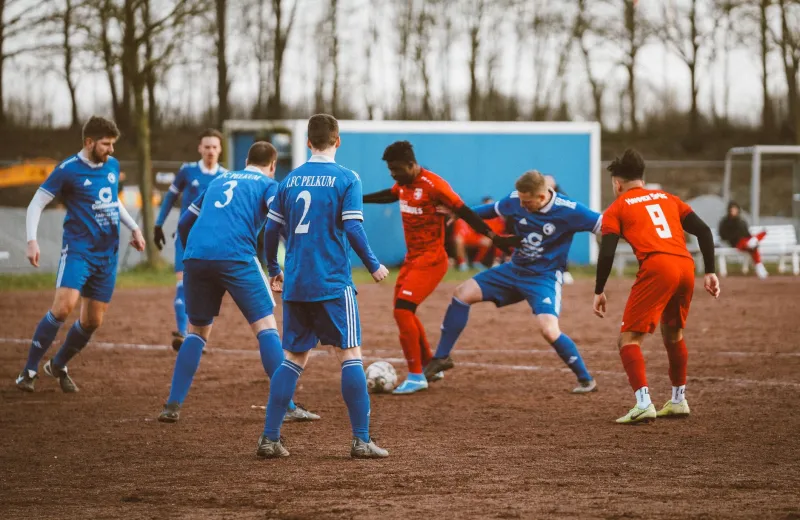
It is 10.12 on a Sunday morning and the ground smells of wet grass, diesel and somebody else's coffee. The warm-up is half-hearted. A linesman is testing a flag as if it might answer back. The referee is walking the pitch with a clipboard, and a dog in a little coat has already found the only dry patch of concrete. I am not here to chase a 1-0 with a long lens. I am here for the bits around the football: the rituals, the regulars and the mud.
At EFC Photography, the best grassroots football frames often arrive before the whistle or after the final shout. They are not always the ones that make the match report. They are the ones that make the morning feel like it happened.
Start before the whistle
Get there early. Not because you need to claim a spot by the dugout, but because the story starts with the pitch inspection. The referee in black, the groundsman with a ring of keys, the captain pointing at a puddle near the corner flag - these are quiet frames with built-in tension. Nobody is performing yet, which is exactly why they work.
Shoot the white line being marked. Shoot boots being laced on the tailgate of a car. Shoot the pile of bibs on a plastic chair. In flat winter light, these small details hold more atmosphere than a mid-air tackle ever will. The light is usually grey and even, which is unglamorous but kind to faces and textures. Embrace it.
Practical note: stay off the pitch unless you have permission. A photographer wandering behind the goal is a distraction, and a distracted goalkeeper is a problem. Work from the touchline, keep your bag tucked in and learn where the substitutes' bench ends. That is your boundary.
The touchline is the story
Sunday league touchlines are their own little village. There is the granddad in the folding chair who comments on every throw-in. The partner with the thermos and the blanket. The substitute in a bib, hopping from one foot to the other. The volunteer linesman who is definitely related to somebody on the pitch. The dog. Always the dog.
These are the frames that give a match its texture. Look for breath in the cold, gloved hands wrapped around a cup, hoods pulled up, a child peering through a fence. A wide frame of the whole touchline can say more than a tight crop of a striker. Try a 35mm or 50mm lens and get close enough to notice expressions, but not so close that you become part of the conversation.
Respect matters more than a good frame. Ask if you are unsure. Do not photograph in or around changing rooms. Do not crowd an injured player. If you are shooting a youth game, follow the club's safeguarding rules and parental consent guidance without making a fuss. A photographer who listens gets better access and better pictures.
Half-time: oranges, tape and truth
The half-time huddle is the emotional centre of a cold Sunday game. Oranges are peeled. Tape is re-wrapped. Steam comes off tea. The team talk is a mix of tactical pointing and somebody saying they cannot feel their toes. This is where you find faces rather than action.
Stand back. Use a slightly wider frame to show the huddle in its setting - the mud, the net, the empty pitch behind. Then move in for the details: hands splitting an orange, a mud-covered shin pad, a water bottle being passed around. Do not interrupt the talk. Do not stand in the middle of the circle. The best half-time photographs are made from the edge, where you are almost invisible.
Low light on a winter touchline is not the enemy. It is just a different set of decisions. Raise the ISO. Open the aperture. Accept a little grain. A shutter speed around 1/250 sec will hold most gestures; drop to 1/125 sec for quieter moments. Meter for faces, not the bright sky. If the light is really flat, look for contrast instead: a red coat against grey mud, a white ball on dark grass, steam against a dark jacket.
The walk back to the car
Full-time is not the end. There are handshakes, nets being untangled, cones being stacked, boots being swapped for trainers. Somebody is scraping mud off a shin with a car key. The tea urn is being emptied. The car park fills with steam and reversing lights. This is where the story closes.
Frame the walk back. A player carrying the net bag. Two teammates sharing a coat. The last parent folding a chair. A final wide shot of the pitch, now empty except for a forgotten water bottle. It is not glamorous, but it is honest, and honest is what grassroots football looks like.
Cold-weather shooting notes
Keep a spare battery warm in an inside pocket. Cold drains them faster than you expect. Carry a lens cloth and a small towel - mud travels. Weather-sealed gear helps, but a plastic bag and some common sense go a long way. Clean your lens before you go home, not next weekend.
Build a sequence rather than a highlight reel: arrival, inspection, touchline, huddle, second half, handshakes, walk back. A story with a beginning and an end will always beat a folder of random action shots.
And keep the long lens in the bag for a bit. The action will still be there. The orange segments will not.