The Last Waltz of the Waltzers: A Funfair's Final Hour in Frames
There is a moment, somewhere after the last ride and before the first van pulls out, when a travelling funfair forgets it is supposed to be loud. The generators keep humming, but the music has stopped. The waltzers are still spinning, just slower, empty. A showman in a fleece walks the length of the dodgems with a broom, and a child's lost trainer sits on the tarmac like a tiny piece of evidence.
That moment is the story. Not the screaming punters or the over-saturated bulbs, but the handover between performance and pack-down. Shooting it well is less about fast lenses and more about patience, manners, and knowing when to put the camera down and ask a question.
The Fair Changes Gear
Arrive early enough to see the fair in full swing, but plan to stay late. The first hour gives you context: queues, sticky fingers, the bloke on the hook-a-duck stall shouting the same joke he has shouted in forty towns. The last hour gives you the actual narrative. The lights are still on, but they are no longer competing with the crowd. Suddenly you can see the scaffolding behind the sparkle.
Permission matters. Travelling showmen are private people, and a fairground after hours is their workplace, not a theme park. A quick word with the ride operator or the family running the tea van goes a long way. Explain what you are doing, show them a frame or two on the back of the camera, and respect a no. Nine times out of ten, a polite ask gets you a better photograph than a long lens ever will.
Chasing Bulbs and Sticky Tarmac
The light is a mess in the best way. You have coloured LEDs, bare bulbs, generator-powered floodlights and that weird orange glow from the burger van. Do not try to neutralise it. Let the fair be the colour it actually is. Expose for the brightest bulbs and let the shadows go deep; the contrast is the point.
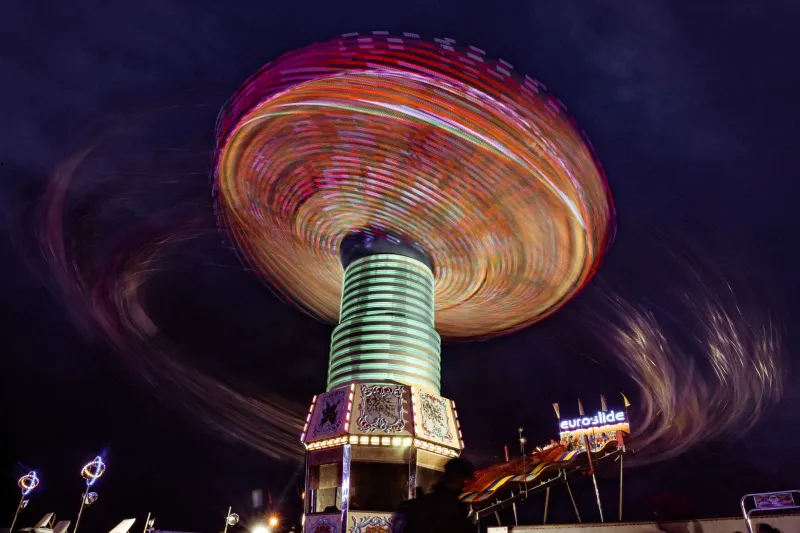
For ride shots, drag the shutter. A half-second exposure turns the waltzers into streaks of light and the dodgems into a blur of bumper cars. Brace yourself against a barrier or use a monopod, and shoot a few frames at different speeds. One second for full abstraction, a quarter-second for something that still reads as a ride. The trick is to keep a sharp element in the frame — a stationary sign, a cable reel, the edge of the ticket booth — so the motion has something to push against.
Portraits When the Crowd Thins
Low-light portraits at a fair are easier once the queue has gone. You are no longer fighting for space, and people have shifted from performer mode into something more honest. Look for the stallholders counting takings, the ride operator coiling a rope, the teenager wiping down the candy floss machine. These are environmental portraits, so keep the fair in the frame. A face lit by a phone screen, with a dead ride behind it, says more than a clean headshot ever could.
Use the available light first. A fast prime — 35mm or 50mm at f/1.8 — and an ISO of 3200 to 6400 will get you there on most modern cameras. If you need a bit of fill, a small LED panel bounced off a nearby van works wonders, but keep it low. You want the fair to still feel like the fair, not a studio with a Helter Skelter backdrop. For the pack-down shots, a shutter speed around 1/60 sec is enough to freeze tired hands without losing the atmosphere.
Cables, Reels and the Ritual of Packing Down
This is where the story really lives. Cable reels stacked like giant cotton buds. A generator ticking as it cools. The tea van serving one last round to people who have been on their feet for twelve hours. Showmen have a rhythm to packing down that is almost choreographed, and once you start watching it, you see the frames everywhere.
Look for hands. A hand winding a cable around an elbow. A hand testing a bulb. A hand holding a mug. These details carry the story of a fair that has to be built and dismantled every few days, and they photograph beautifully in low light. Get close, ask first, and do not use flash unless you have built a bit of trust. A silent shutter and a respectful distance will get you further than a burst of light in someone's face.
The Ride Home Begins
As the first van reverses into position, the fair becomes a series of geometric shapes: ramps, panels, tarpaulins. The mood shifts again, from tired to efficient. This is the part most photographers miss because they leave when the lights go off. Stay for it. The image of a showman silhouetted against a half-packed ride, or a child asleep in the cab of a truck, is the ending your story needs.
Shoot the last hour like you are saying goodbye. Because the fair is already saying goodbye to that field, that town, that particular cast of punters. Your photographs are the only thing that will remember the in-between.