The Night Before Opening: Photographing Amateur Theatre When the Seams Still Show
There is a particular smell to a final dress rehearsal. Hairspray, dust from the heating, a faint whiff of someone's sausage roll, and the sharp tang of fresh gaffer tape. I was in a converted church hall on the edge of town, camera bag over one shoulder, trying to work out whether the black-clad figure by the lighting desk was the director or the vicar. It turned out to be both, sort of. Welcome to amateur theatre.
Opening night was two days away. This was the last run-through before an audience would be let in, which meant everything was nearly right and nothing was quite finished. A costume rail blocked the fire exit. Someone was hunting for a missing shoe. The piano had gone slightly sharp. And the cast — volunteers, all of them, with day jobs and families and a genuinely alarming commitment to learning lines in the car — were running the whole thing from the top.
I love shooting this stage of a production. Not the polished press night, but the night when the seams still show.
Getting In Without Getting In the Way
Amateur companies are generous with access, but access is not the same as permission to be a nuisance. Before I unpacked a single lens, I found the stage manager, introduced myself properly, and asked where I could stand without blocking a sightline or a quick change. We agreed on two zones: one at the back of the hall for wide frames, and one just off stage left for the tighter stuff. No flash. Silent shutter on. Black clothes, soft shoes, phone on silent.
The other rule I set myself is simple: I do not move during a scene. If I need a different angle, I wait for the blackout. It sounds obvious, but a photographer wandering about during a quiet moment is the fastest way to get politely asked to leave. The rehearsal is for them, not for me.
The Stage Light Is a Beautiful Liar
If you have only ever shot in daylight, stage lighting will feel like a practical joke. One minute you have a warm tungsten wash that makes everyone look like they are in a 1970s sitcom, and the next a hard LED spot is carving shadows under eyebrows while a blue gel turns a perfectly nice waistcoat into a smear of ink. Mixed colour temperatures are the norm, not the exception.
I shoot RAW, set white balance to something sensible — often around 3200K for the warmer lamps — and accept that I will be correcting each frame differently later. Chasing a single perfect white balance across a whole show is a fool's errand. The colour is part of the story. A cold blue for the dream sequence and a sickly green for the ghost are not mistakes; they are the design.
The bigger problem is exposure. Stage costumes often involve white shirts, and white shirts under a follow spot will blow out if you let them. I meter for the highlights, usually spot-metering on a face or a bright sleeve, and let the shadows fall where they fall. High ISO is your friend here. I would rather have grain at 6400 than a blurry actor. A 35mm f/1.8 and an 85mm f/1.8 cover almost everything, and a shutter speed of 1/250 sec handles most movement. For the dance numbers, I push to 1/500 sec and accept the noise.
Backstage Is Where the Story Lives
The performance frames are the ones the company will put on the poster. The backstage frames are the ones they will text each other about three weeks later. That is the trade-off of a dress rehearsal: you get both, if you are patient.
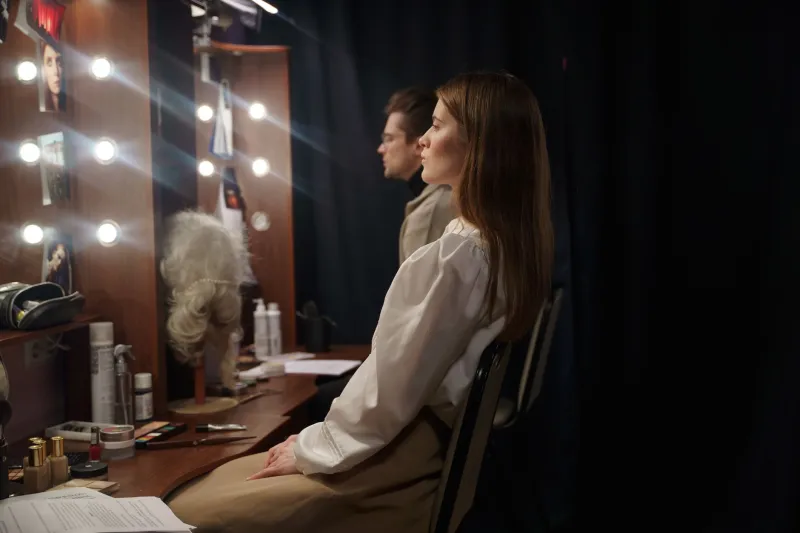
I spent the interval — such as it was — in the wings, photographing the things nobody photographs. A teenager having her hair pinned by her mum. Two actors running lines in the corridor, scripts held like prayer books. A row of identical shoes, one of them held together with tape. The dress rail with a name tag that had been crossed out and rewritten twice. These are the quiet frames that make a production feel like a human effort rather than a polished product.
A small LED panel helps backstage, but only if you can bounce it off a wall and keep it dim. Mostly I use whatever light is already there — a bare bulb over a mirror, the glow from a laptop, the spill from the stage itself. Silent shutter is non-negotiable. The last thing you want is a click during someone's pre-show breathing exercise.
Portraits in the Wings
When I do want a tighter portrait, I look for the moments when an actor is holding a beat: waiting to go on, listening to a cue, standing in the dark with a prop in one hand. That is when their face does something real. I shoot through gaps in the flats, use the stage light as a rim, and get low so the frame feels more dramatic than the actual church hall carpet deserves.
Volunteers who are not used to being photographed will often freeze the moment they see a lens. The trick is not to ask them to relax — that never works — but to give them something to do. Hold this letter. Look at that mark. Count to five. I show them the back of the camera afterwards, and I never say the word 'smile'. A real expression is worth ten posed ones.
What I Took Away
By the end of the night I had around four hundred frames. Maybe forty will survive the first cull. The selects are rarely the ones I expected: a half-lit face in the wings, a hand adjusting a collar, the entire cast crammed into a corridor for a pre-show huddle that lasted eight seconds. The performance shots are clean and dramatic, but the backstage ones are the ones that feel like a story.
I sent a small gallery over the next morning, before the nerves of opening night could take hold. The director replied with a photo of the whole company crowded round a laptop, still in half their costumes, pointing at themselves and laughing. That is the frame I did not take, and it is the one I will remember. Amateur theatre is not about perfection. It is about people showing up, taping their shoes together, and doing the thing anyway. The camera just gets to stand in the wings and watch.