Top Deck, 1am: The Night Bus as a Portrait of a Town Shutting Down
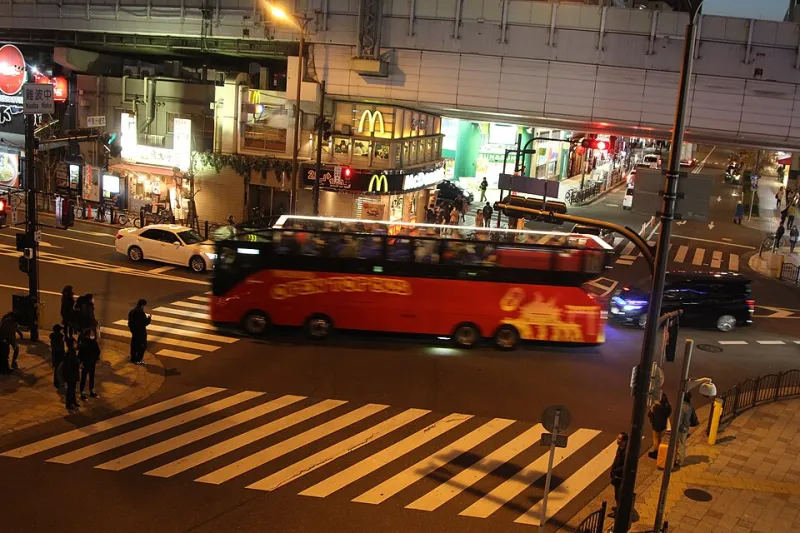
Photo: Tokage854611, CC BY-SA 3.0, via Wikimedia Commons
The 1am bus does not arrive so much as materialise. One minute the stop is just a damp slab of pavement under a flickering streetlamp; the next there is a diesel rumble, a hiss of doors and a wash of cold fluorescent light across the queue. For EFC Photography, this is the kind of story that never makes the front page but says more about a town than any civic portrait ever could.
I rode the last service between the town centre and the outer estates on a wet Thursday in November. Not to document 'characters', and certainly not to make a exhibit of people who were simply trying to get home. The aim was simpler: to see what the bus looks like when the pubs have called time, the takeaways are still open and the only people left in the centre are the ones who have to be.
The queue is the first frame
You can learn a lot from a bus queue at 1am. There is the chip-shop paper folded into a neat triangle, the kebab-shop carrier bag held by the corners, the lanyard from a late shift, the damp hood of a coat that has been rained on since 6pm. Nobody is posing. Nobody is performing. The queue has its own choreography: a half-step forward, a glance at the timetable, a shared shrug when the display says the bus is eight minutes away and then, somehow, eleven.
I shot the queue from the side, not head-on. A 35mm equivalent lens on a modest f/2.8 zoom, ISO pushed high enough that the grain became part of the texture. The streetlight did most of the work. The bus, when it finally arrived, did the rest.
Strip lighting is not the enemy
Inside, the top deck has its own weather system. The strip lights run down the ceiling in hard little lines, reflecting in the windows and turning every face into a study in pale green and shadow. A lot of photographers would reach for flash here. I didn't. A direct flash on a night bus is a small explosion of attention, and attention is the last thing most passengers want at that hour.
Instead, I let the bus light the bus. I metered for the highlights on the handrails, kept the shutter speed just fast enough to hold the sway of the top deck, and accepted that some frames would be soft at the edges. The grain is honest. The colour cast is honest. The slight blur where the bus turns a corner is honest too.
Where a face was readable, I asked. A nod towards the camera, a quiet 'all right?' and a thumbs-up was usually enough. If someone turned away, that was the answer. The story works better with the backs of heads, hands, carrier bags and reflections anyway.
Fish and chips, a fag break and the in-between hour
At the bus station, the driver took his break. A couple of passengers drifted towards the shelter, one lighting a cigarette with the practised cupping of a hand that has done it in the rain a thousand times. The chip shop across the road was cashing up, its window still glowing. The smell of vinegar and hot fat cut through the diesel. It was not glamorous. It was not meant to be. It was just the hour between work and sleep, the bit of the night that rarely gets photographed because it does not look like a night out.
That is the frame I kept coming back to: the paper tray balanced on a knee, the steam curling up in front of a bus window, the reflection of a phone screen on a tired face. Small rituals. Nothing staged. The bus was already a stage set, and all I had to do was wait for the actors to forget I was there.
The quiet conversations
Top-deck conversations at 1am have a different volume. Two lads comparing shifts. A woman on the phone saying she would be home in twenty minutes, no, twenty. A couple sharing a pair of earphones, one bud each. A man asleep against the window with his hood up, waking at his stop with the sudden, startled efficiency of someone who has done this route many times before.
I did not record any of it. I did not need to. The photographs rely on the pauses between the words: the hand on the rail, the carrier bag between the feet, the face turned towards the black glass and the town sliding past in reverse. You do not have to show everything to show enough.
What the last stop looks like
Eventually the bus empties. The last passenger gets off at the top of an estate, the doors close with a pneumatic sigh, and the bus pulls away. The stop is just a shelter, a timetable and a puddle with a streetlight in it. Somewhere behind a curtain a telly is still on. A dog barks once. The town is not asleep, exactly. It is just running on a different shift.
That is the final frame for me: not a punchline, not a moody silhouette, just the ordinary after-hours quiet. The night bus is not a dramatic subject. It is a moving room full of people who have had long days. Photograph it gently, and it becomes a portrait of the town that keeps going after the shops pull down their shutters.